
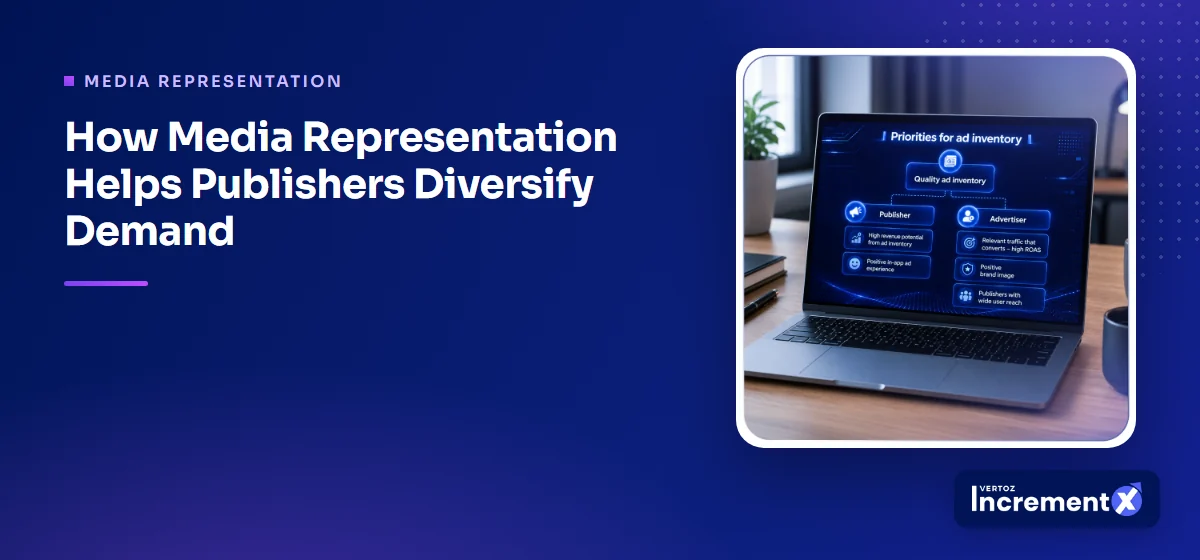
Media representation helps publishers diversify demand by putting their inventory in front of more kinds of buyers, through more kinds of deals, across more channels. Instead of leaning on one platform or one auction, a represented publisher earns from a mix of direct relationships, private and guaranteed deals, curated packages and open programmatic demand. That mix makes revenue steadier and less exposed to any single change.
What is demand concentration risk?
Demand concentration risk is what happens when too much of your revenue depends on too few sources. It is the advertising version of a business that has one big customer. Things look fine until that customer leaves.
For publishers, concentration usually shows up in one of four ways:
- One buyer or agency accounts for a large share of direct revenue.
- One platform or demand partner delivers most programmatic revenue.
- One deal type, usually the open auction, carries almost everything.
- One channel, such as desktop web, provides nearly all impressions.
None of these is wrong on its own. The open auction is a valuable source of demand, and many publishers start with a single platform for good reasons. The risk comes from depending on one route so heavily that a policy change, a budget cut or a technical issue elsewhere can move your revenue overnight.
Why is a single source of demand fragile?
Each demand route has its own weak points. Auction prices move with buyer budgets and seasonality. A platform can change its fees, its rules or the way it values your inventory. A single large direct advertiser can shift strategy at the next planning cycle. A channel can be affected by changes to browsers, devices or measurement.
When your revenue is spread across routes that respond to different pressures, a dip in one is often softened by stability in another. That is the core idea behind diversification. It does not guarantee growth, but it reduces how badly a single shock can hurt.
The main types of demand a publisher can blend
A diversified mix uses demand types that behave differently from one another. Here is a plain-English view of each.
| Demand type | What it is | What it adds to the mix |
|---|---|---|
| Direct | Deals agreed directly with an advertiser or agency | Relationship-based revenue and premium pricing for well-understood inventory |
| Programmatic guaranteed (PG) | Reserved inventory at a fixed price, delivered through programmatic systems | Predictable volume and pricing with automated delivery |
| Private marketplace (PMP) | An invite-only auction for selected buyers | Price discovery among buyers who value your inventory, with more control |
| Open auction | Real-time bidding open to many buyers | Broad reach and a way to monetize remaining impressions |
| Curated deals | Packages that group inventory around an audience, context or format | Easier buying for advertisers and access to budgets that want a defined outcome |
| Agentic buying | Advertiser-side AI agents discovering inventory and initiating deals | An emerging route to buyers who plan through AI tools |
Analysis
There is no single "correct" proportion for these demand types. The right mix depends on your audience, your content, your sales capacity and how much inventory is premium. The useful question is not "what is the ideal split?" but "if one route weakened tomorrow, how much would we lose?"
Channel mix: the second layer of diversification
Demand diversity is one layer. Channel diversity is another. A publisher that only monetizes desktop web is exposed to anything that affects that environment, even if its deal mix is healthy.
Where a publisher already has audiences across environments, representation can help each of them earn properly. Web inventory, mobile app inventory and connected TV (CTV) inventory each attract different buyers and budgets. A brand building awareness might favour CTV, while a performance advertiser might lean on in-app formats such as rewarded or interstitial ads. Bringing these channels into one represented offer can widen the set of buyers who have a reason to work with you.
The point is not that every publisher should launch an app or a streaming channel. It is that existing channels should not be left underrepresented simply because the sales effort was focused elsewhere.
How does media representation build a more diverse demand mix?
Media representation is the practice of a specialist partner presenting a publisher's inventory to advertisers and buyers on its behalf. Several parts of that work directly support diversification.
It adds buyer relationships you do not have
Many publishers are well connected to one or two platforms but have few direct links to agencies, brands or trading desks. A representation partner brings existing relationships and introduces your inventory to buyers who would not otherwise find it.
It packages inventory for different buying styles
A guaranteed buyer, a PMP buyer and a curated-package buyer want different things. Representation shapes the same underlying inventory into offers that suit each style, so one placement can earn through several routes depending on who is buying.
It shows you where you are concentrated
An outside view often spots concentration that an internal team has stopped noticing. Reviewing revenue by buyer, route, deal type and channel makes the risk visible, and that is the first step toward reducing it.
It prepares inventory for new routes
Emerging routes, such as AI-driven buying, need inventory that is clearly described and discoverable. A representation partner can help make sure your inventory is ready when those buyers arrive.
Example (illustrative)
A niche-audience motoring publisher earns most of its revenue from the open auction through one platform, with a single direct sponsor each year. When that sponsor reduces its budget, revenue drops sharply. Working with a representation partner, the publisher sets up a PMP for automotive buyers, a small PG package around its most-read review pages, a curated contextual package for car care brands and an in-app offer for its existing mobile audience. The open auction still matters, but it now sits beside four other routes that respond to different market pressures.
Questions to ask about your own demand mix
- What share of revenue comes from our single largest buyer or platform?
- How much of our income relies on the open auction alone?
- Do we have at least one guaranteed or private deal route working today?
- Are all of our channels (web, app, CTV) represented to buyers, or only one?
- Is our inventory described clearly enough for new buying routes, including AI agents?
How IncrementX supports a diversified demand mix
IncrementX is a global media representation partner. Our Media Representation work covers inventory understanding, demand mapping, inventory packaging and advertiser alignment for web, app, CTV and OTT publishers, video owners, premium content platforms, high-traffic sites and niche-audience publishers.
Represented inventory can reach demand through direct relationships, curated deals, PMP and programmatic routes. Our Demand Marketplace connects inventory with brands, agencies, DSPs, trading desks and programmatic buyers, using deal types including PMP, PG, audience, contextual, custom deals and curated packages.
For the newest route, our IncrementX Seller Agent lets authorized AI buying agents discover represented inventory and initiate deal creation today. Wider agent-to-agent buying workflows are still being built with partners, so we see agentic demand as a growing addition to a publisher's mix rather than a replacement for what already works. To understand how PMP and PG fit into this picture in more depth, read how PMP and PG deals redefine publisher revenue streams.
Building resilience, one route at a time
Diversification rarely happens in a single step. Most publishers add one new route, learn from it and then add the next. The important shift is in mindset: treating demand as a portfolio to be balanced, not a single pipe to be maximised. Representation gives that portfolio the relationships, packaging and visibility it needs to grow steadily.