
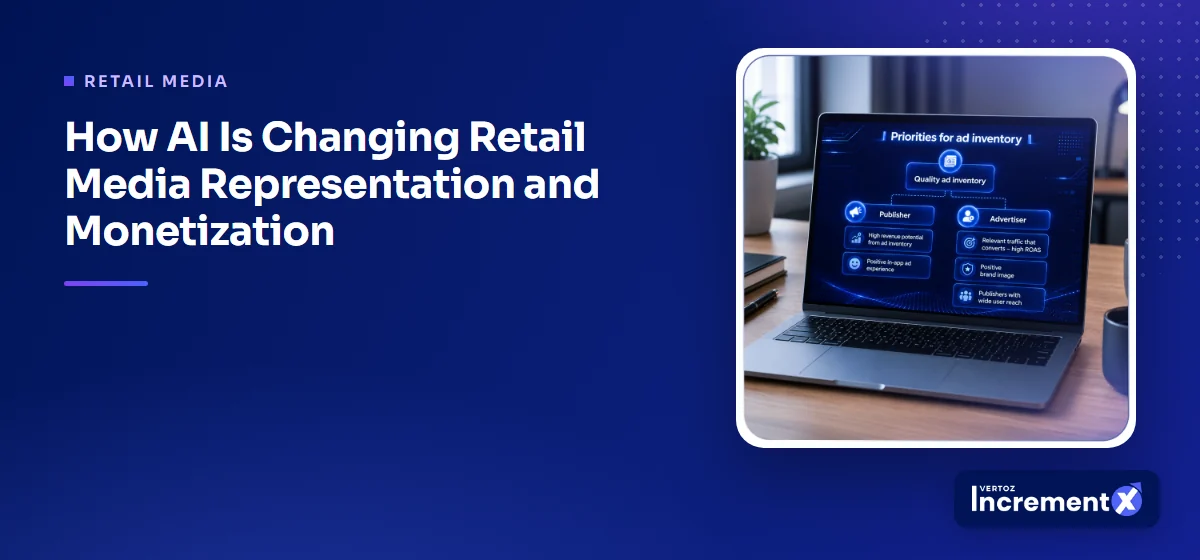
AI is changing retail media representation mainly by making it faster to read inventory performance, spot patterns and test decisions about pricing, packaging and demand. The most useful applications today are practical and AI-assisted: people still set the strategy and approve the decisions, while software surfaces what is worth acting on. Retailers that get value from AI usually start with clean data and a clear inventory structure, not with the model.
This article looks at where AI genuinely helps a retailer sell its media, where it does not, and what to put in place first.
Why retail media is a good fit for AI assistance
Retail media produces a lot of structured data. Every placement has impressions, a fill rate (the share of available ad slots that are actually filled), prices, bid activity and, often, links to shopping outcomes. Across hundreds of category pages, search terms and app screens, that is more than a commercial team can review by hand each week.
AI tools are good at exactly this kind of work: scanning many signals, flagging changes and suggesting where attention would pay off. They are less good at judgement calls that depend on relationships, brand rules or a retailer's long-term strategy. Keeping that division clear is the first step to using AI well.
Four practical uses of AI in retail media representation
1. Reading yield signals
Yield optimization means getting the best overall return from your inventory, balancing price, fill and the experience for shoppers. AI-assisted analysis can watch signals such as:
- eCPM, the effective revenue per thousand impressions
- Fill rate by placement, device and time of day
- Viewability and, for video, completion rates
- Bid behaviour and demand response, meaning how buyers react when floors or packages change
- Floor performance, whether minimum prices are helping or blocking demand
- Revenue trends over days, weeks and seasons
The value is not a single number. It is spotting, for example, that a placement's floor price is turning away buyers on weekday mornings, or that a video unit's completions dropped after a page redesign.
2. Packaging inventory buyers understand
Retailers often have inventory that is valuable but hard to buy because it is described in internal terms. AI can help group placements by context, category, format and audience signals into packages that match how advertisers plan. A human team then reviews and names those packages so they make sense to a buyer.
Example (illustrative)
A mid-size home and garden retailer has dozens of category pages with uneven performance. An AI-assisted review groups them into a "spring outdoor projects" contextual package and a "kitchen renovation" package based on traffic patterns and past demand. The commercial team checks the groupings, removes pages with weak viewability and offers the packages as curated deals for the season.
3. Forecasting availability and demand
Retail traffic is seasonal and event-driven. AI-assisted forecasting can estimate how much inventory a placement is likely to have over a period, and how demand may change around peak trading moments. That helps a retailer decide what can be offered on a guaranteed basis and what should stay in auction-based deals.
Forecasts are estimates. They should be shown with ranges and reviewed against actual delivery, so that commitments to buyers stay realistic.
4. Making inventory easier to discover
Inventory discovery is how buyers find and evaluate media opportunities. AI is starting to change this from both sides. Buyers increasingly use AI tools to research and shortlist inventory, and sellers can make their inventory easier for those tools to read by describing it in consistent, structured terms: category, geography, device, format, pricing and deal type.
This is the bridge to agentic advertising, where software agents act on behalf of buyers and sellers. On the sell side, agentic inventory discovery through IncrementX Seller Agent lets authorized AI buying agents find represented inventory and initiate deals. We cover that in more depth in agentic advertising and the future of retail media monetization.
Where AI does not replace people
Analysis
This is our view of where human judgement remains essential. It reflects general practice in media sales rather than findings from a study.
- Pricing policy. AI can suggest floors, but a retailer must decide how it balances revenue, shopper experience and advertiser relationships.
- Brand and supplier relationships. Many retail media buyers are also suppliers to the retailer. Those conversations need context that data does not hold.
- Brand safety and category rules. What a retailer will and will not allow on its pages is a policy decision.
- Data use. Which shopper data may support advertising is set by consent and law, not by what a model could use.
What to put in place before using AI
AI makes good inputs more useful. It does not fix poor ones. Before expecting much from any AI-assisted tool, a retailer can check:
- Every placement has a stable, consistent name and description
- Core metrics (impressions, fill rate, eCPM, viewability) are reported the same way across channels
- Deal types and packages are tracked separately in reporting
- There is a clear owner for reviewing AI suggestions and recording decisions
- Consent and data-use rules are documented and applied to any audience signals
How IncrementX approaches AI in representation
IncrementX is a global media representation partner. Representation comes first: understanding inventory, mapping it to demand and packaging it so advertisers can buy it. Technology supports that work.
Our Agentic AI Monetization capability is AI-assisted monetization intelligence. It looks at signals such as eCPM, fill rate, viewability, completions, revenue trends, demand response, bid behaviour and floor performance, and supports decisions about yield, demand competition, pricing and formats. It is designed to inform decisions, not to take autonomous control of a media business. You can read more about the concept in what is agentic monetization and the glossary entry for agentic monetization.
Retail media is a new area of focus for IncrementX. On our retail media representation page, we explain how a representation partner can help retailers bring their media to market. Where a retailer has well-structured inventory and clear data rules, AI-assisted analysis can help a representation team spend less time assembling reports and more time on packaging, pricing and buyer conversations. For the publisher side of the same topic, see AI in publisher representation and monetization.
Questions to ask about any AI-assisted monetization tool
Whether you build in house or work with a partner, these questions help separate useful AI from marketing language:
- Which signals does it actually use, and where do they come from?
- Does it recommend actions, take actions, or both? If it takes actions, what are the limits and who approves them?
- How are recommendations explained, so your team can see why a change is suggested?
- How is shopper data handled, and does any of it leave your control?
- How will you measure whether the suggestions improved programmatic monetization and overall revenue, not just one metric?
The direction of travel
The likely path for retail media is not a sudden switch to fully automated selling. It is a steady increase in how much routine analysis software handles, alongside more structured, machine-readable descriptions of inventory so that buyers' tools can find it. Retailers that invest in clean data, clear packaging and human oversight will be in a good position to benefit from each step, whatever the pace of change turns out to be.