
90% of large publishers use header bidding, but most are still leaving money on the table. Not because the technology does not work. It does. But setting up header bidding and having it work correctly are two very different things. Most publishers do the first and assume the second has followed automatically. It usually has not. This post is for two kinds of readers. If you have never set up header bidding and are trying to understand whether you should, the first few sections are for you. If you already have it running and are not sure whether it is actually performing, start from the section on what most publishers get wrong. Either way, by the end of this, you will know exactly what to look for and what to do about it.
Table of contents:
- What Is Header Bidding?
- Why Most Publishers Are Still Leaving Revenue Behind
- The Five Things Most Header Bidding Setups Get Wrong
- How to Know If Your Header Bidding Is Working
- Should You Start Header Bidding If You Have Not Already?
- What Changes When You Have the Right Demand Behind It
- Frequently Asked Questions
What Is Header Bidding?
Header bidding is a way for publishers to let multiple advertisers compete for the same ad impression at the same time, before the ad server decides who wins.
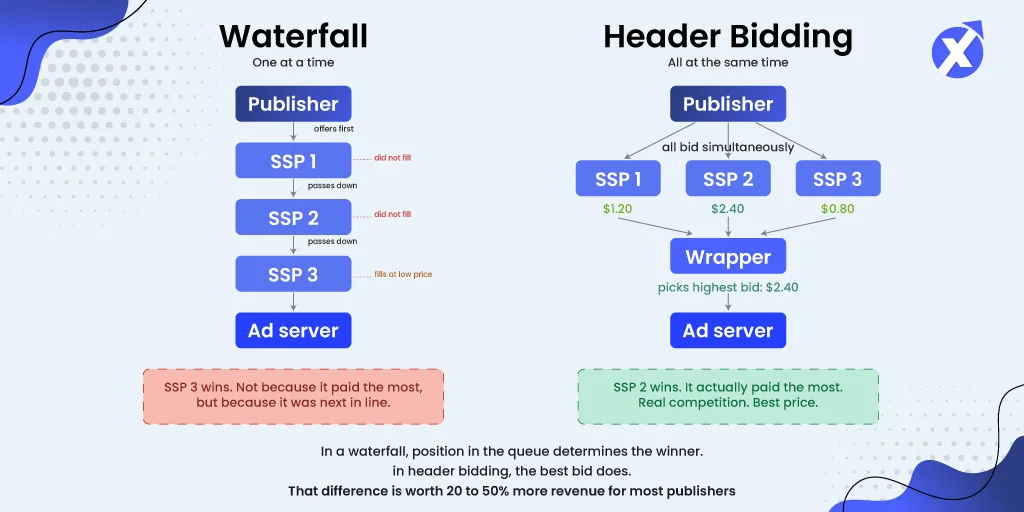
Before header bidding existed, the standard approach was called the waterfall. Publishers would offer their ad space to one network at a time. If the first network did not fill the impression, it passed to the second, then the third, and so on. The problem: advertisers higher in the waterfall had an unfair advantage regardless of how much they were actually willing to pay. A buyer further down the list might have been willing to pay twice as much, but never got the chance to bid.
Header bidding fixes that by running a simultaneous auction. Every demand partner sees the impression at the same time and submits their best bid. The winner is whoever actually pays the most, not whoever happened to be first in line. More competition means higher prices. Higher prices mean more revenue per impression.
That is the core idea. A small piece of JavaScript code called a wrapper sits in the header of your page, runs the auction, and passes the winning bid to your ad server.
Why Most Publishers Are Still Leaving Revenue Behind
Here is the problem nobody talks about when they explain header bidding.
The technology is only as good as the setup behind it. Most publishers operate with suboptimal configurations that quietly suppress revenue by 15 to 30%. The difference between a properly configured wrapper and a neglected one can mean hundreds of thousands in lost annual revenue.
That stat is not about publishers who do not use header bidding. It is about publishers who do use it, but set it up once, never touched it again, and assumed things were fine.
Three things tend to go wrong silently:
Floor prices get set once and never reviewed. The bid landscape changes every quarter. A floor that made sense six months ago may be too low today, which means you are accepting bids you could have pushed higher. Or it is too high, which means you are blocking legitimate buyers and leaving impressions unsold.
Demand partners accumulate without review. It feels counterintuitive, but adding more bidders does not always mean more revenue. Most publishers see optimal results with five to twelve demand partners. More partners increase competition but also add latency and management complexity. Partners who are not actually bidding competitively are just slowing your pages down.
Nobody is watching the numbers. Bid rates, win rates, timeout rates; these metrics tell you whether your auction is healthy. Most publishers check revenue reports. Very few check the auction data underneath.
The Five Things Most Header Bidding Setups Get Wrong
These are the most common revenue leaks, in order of how often we see them.
- Floor prices that have not moved in months
Perplexity is not included in GA4’s native AI Assistant channel. As of June 2026, sessions from Perplexity continue to land in Referral, mixed in with everything else. This matters because Perplexity sends some of the most intentional traffic of any AI tool. People who search on Perplexity are usually researching something specific. They clicked through because the answer cited your page. That visitor came with a reason.
Your floor price is the minimum you are willing to accept for an impression. If it is too low, you are training buyers to bid low because they know they can get away with it. Bidders that had been sending low bids were found to immediately match each new floor price increment, proving they were willing to pay more all along. The money was always there. The floor just was not asking for it.
Set a floor and review it at least monthly. The right floor changes by device type, geography, ad format, and time of day. A single flat floor across all your inventory is almost certainly leaving something on the table.
- Wrong number of demand partners in the wrapper
More partners sounds like more competition. Up to a point, it is. But every bidder adds latency to your page. If the slowest bidder in your wrapper takes 800 milliseconds to respond and your timeout is set at 1 second, the faster bidders are all waiting around for one slow one.
Audit your demand partners every quarter. Check who is actually bidding and who is just sitting in the wrapper collecting impression data without contributing revenue. Cut the underperformers and test new ones in their place.
- Timeout settings nobody has reviewed since setup
Your timeout setting determines how long the wrapper waits for bids before it gives up and moves to the ad server. Set it too short and fast-bidding partners win everything while slower premium buyers miss the auction. Set it too long and your page loads slowly, which hurts user experience and can affect your ad revenue indirectly through higher bounce rates.
Your wrapper timeout setting represents one of the most critical yet overlooked parameters in your entire monetisation setup. Most publishers set it during implementation and never revisit it. Review it seasonally.
- No one is checking bid rate and win rate
These two metrics tell you more about the health of your header bidding setup than revenue reports do.
Bid rate is how often a partner responds to an ad request. A healthy setup has a bid rate of 60 to 80 percent. Warning signs include declining bid rates, increasing timeouts, bid distributions shifting lower, and fewer unique bidders.
Win rate is how often a partner wins the auction compared to how often they bid. A partner with a very low win rate is bidding but never competitive enough to win. They are adding latency without adding revenue.
If you are not looking at these numbers, you are flying blind.
- Client-side setup that was never evaluated for server-side
Client-side header bidding runs in the user’s browser. Server-side moves the auction to a server before anything reaches the browser. Server-side is faster for users but has historically had lower match rates because it relies less on cookies for audience data.
In 2026, hybrid approaches are becoming the norm. Publishers can prioritise high-performing partners in client-side auctions while routing additional demand through server-side channels, achieving a balance between transparency, competition, and efficiency. If you have never evaluated whether a hybrid approach makes sense for your traffic profile, it is worth the conversation.
How to Know If Your Header Bidding Is Working
You do not need a complex analytics platform to run a basic health check. Here is what to look at.
Open your Prebid analytics or whatever reporting your setup provides. Look for:
Bid rate below 60 percent on your main demand partners. This signals that partners are not finding your inventory attractive, which could be a floor price issue, a technical misconfiguration, or simply the wrong partners in your wrapper.
Timeout rate above 10 to 15 percent. If that many bids are timing out, your timeout setting may be too short, or specific partners are consistently slow and need to be removed.
One or two partners winning the vast majority of impressions. This suggests the rest of your demand partners are not genuinely competitive. More partners on paper, less competition in reality.
Revenue staying flat even as your traffic grows. This is the most common signal that something in the setup is not working correctly. Traffic should translate to revenue at a relatively predictable rate. If it is not, the auction is the first place to look.
Should You Start Header Bidding If You Have Not Already?
If you are a publisher who has not yet implemented header bidding, the honest answer is: it depends on your scale and your technical resources.
Header bidding benefits publishers of all sizes, but implementation complexity favors larger publishers with dedicated ad ops teams. The revenue increase typically justifies the effort once monthly page views exceed one to two million.
If you are below that threshold, a managed header bidding solution through a representation partner is likely a better starting point than trying to build and maintain a Prebid wrapper yourself. You get the revenue benefit without needing an in-house ad ops specialist to keep it running.
If you are above that threshold and not yet running header bidding, you are almost certainly leaving significant revenue on the table every month. Header bidding typically increases publisher programmatic revenue by 20 to 50 percent compared to waterfall setups. That is not a small number.
What Changes When You Have the Right Demand Behind It
Header bidding is the tool. The demand partners in your wrapper are what determine whether it performs.
You can have a perfectly configured wrapper: right floor prices, right timeout settings, right number of partners, clean bid rate, and still underperform if the buyers competing in your auction are not the right ones for your audience and your geography.
This is the piece most publishers do not think about until the numbers tell them something is wrong. The technical setup of header bidding is solvable with the right guidance. But connecting your inventory to the demand that actually values it, in the markets where your audience is, is a different kind of work.
For publishers in India, Southeast Asia, MENA, and multicultural markets in the US, the gap between what header bidding generates with generic demand and what it generates with the right demand representation is significant. Not because the technology is different, but because the buyers competing for your inventory are.
Frequently Asked Questions
What is the difference between header bidding and waterfall?
In a waterfall, publishers offer ad inventory to one network at a time in a fixed sequence. Each network gets a chance to fill the impression before passing it to the next. In header bidding, all of the demand partners bid at the same time, before the ad server is called. This drives real competition, and usually higher CPMs, because the highest real bid wins, not the highest bid from whoever is first in line.
How many demand partners should I have in my header bidding wrapper?
Research suggests five to twelve demand partners is optimal for most publishers. Too few and you have limited competition. Too many and you add latency that slows page load, which can hurt user experience and bid quality. The number matters less than the quality. Five strong, active demand partners will outperform fifteen inactive or low-bidding ones every time.
What is a healthy bid rate for header bidding?
A healthy bid rate is usually between 60 and 80 percent. If you’re consistently below 60 percent, it’s a signal that demand partners aren’t finding your inventory competitive enough to bid on. This could be due to floor prices, targeting mismatches, or technical issues with how your bid requests are being sent.
Can I run header bidding alongside Google Open Bidding?
Yes, and most publishers do. The header bidding auction runs first, and the winning bid then competes in Google Ad Manager against Open Bidding, direct deals, and Ad Exchange. The question is not whether to run both but whether the incremental revenue from Open Bidding justifies the latency it adds to your setup.
How do I know if my floor prices are set correctly?
The clearest signal is your bid density data. If the majority of winning bids are landing just above your floor price, your floor may be too low; buyers are paying the minimum they have to. If your fill rate is dropping alongside rising floors, you have gone too high and are blocking buyers. Floor prices should be reviewed monthly and calibrated by device type, geography, and ad format rather than set as a single flat number across all inventory.
Does header bidding work for app publishers?
Yes, though the implementation is different from web. In-app header bidding typically uses SDK-based bidding rather than a JavaScript wrapper. In-app is one of the few environments where Open Bidding performs comparably to Prebid, because the data constraints that affect server-side bidding on the web matter less in app environments where device-level identifiers serve a similar function. App publishers should evaluate both SDK-based header bidding and mediation platform options based on their specific traffic profile.
At IncrementX, we work with publishers to make sure the inventory is reaching the demand it deserves, not just the demand that happens to be in the wrapper. If you want to talk through your current header bidding setup and whether it is performing at the level it should be, reach out. No complicated pitch. Just a look at the numbers together.
IncrementX is The Publisher’s Representation Partner. We help publishers earn more from the inventory they already have, across North America, India, MENA, and Southeast Asia.