For the past two years, a lot of publishers have been receiving visitors from ChatGPT, Perplexity, Gemini, and other AI tools without knowing it. Those visits were getting lumped in with everything else in Google Analytics, buried under generic referral traffic and direct sessions. You could not see them, so you could not make decisions based on them.
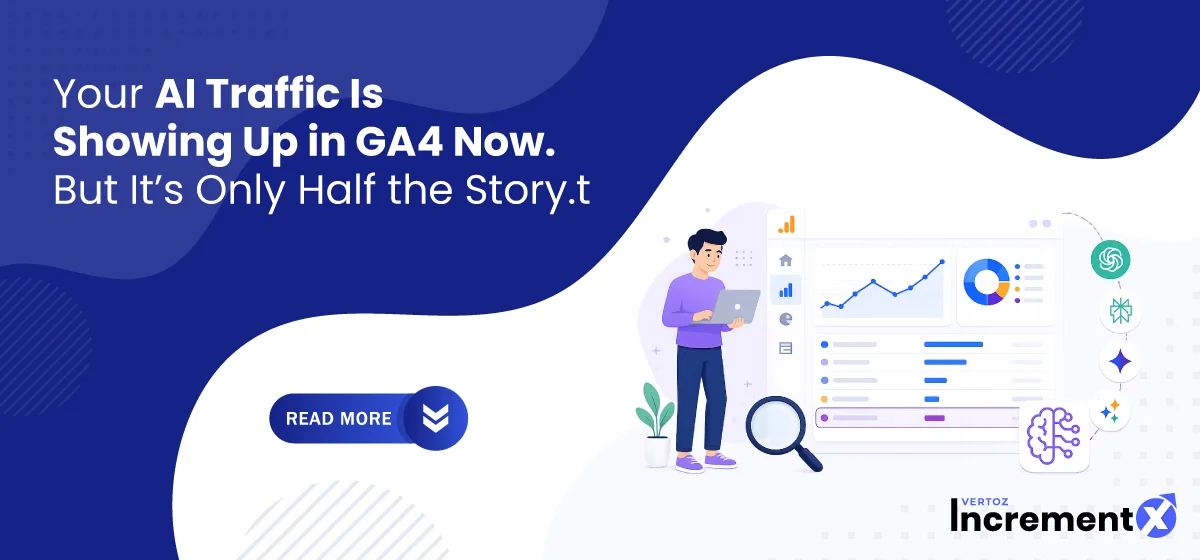
That changed in May 2026. Google added a dedicated AI Assistant channel to GA4, and it works automatically. No setup required. Open your Traffic Acquisition report today, and you might already see it sitting there as its own row, separate from organic search, paid traffic, and referrals.
It is a genuinely useful update. But for publishers specifically, the number you see in that channel is almost certainly smaller than reality. And more importantly, even the accurate number tells you less than you might think if you only look at it the way everyone else does.
Here is what you actually need to know.
Table of contents:
- What GA4’s AI Assistant Channel Actually Does
- The Part That Everyone Gets Wrong
- Which AI Tools Are Sending Traffic (and Which Are Not Being Tracked)
- The Question Publishers Should Actually Be Asking
- What to Do With This Information
- Why This Is Worth Paying Attention to Now
- Frequently Asked Questions
What GA4’s AI Assistant Channel Actually Does
When someone reads an AI-generated answer on ChatGPT or Gemini and clicks a link through to your site, GA4 now catches that visit and puts it in a dedicated bucket. Before this update, that same session might have shown up anywhere. Sometimes it appeared in Referral traffic. Sometimes it vanished into Direct sessions. Either way, you had no clean way to isolate it without building a custom filter from scratch.
The update assigns three values automatically to sessions from recognised AI tools:
- The medium gets set to “ai-assistant”
- The session goes into the new AI Assistant channel group
- The campaign is labelled “(ai-assistant)”
You can find it in Reports, then Acquisition, then Traffic Acquisition. Switch the primary dimension to the Session default channel group. If the rollout has reached your property, you will see AI Assistant as its own line.
The platforms currently captured in the native channel as of June 2026 are ChatGPT, Gemini, DeepSeek, Copilot, and Grok. The list started smaller and has been quietly updated since launch. Worth checking Google’s own help documentation periodically rather than relying on any single article’s summary, including this one.
The Part That Everyone Gets Wrong
This is where most coverage of this update stops. It explains what the channel is, tells you how to find it, and calls it a day.
But there is a problem that fundamentally changes how you should interpret the number you see there.
Between 35 and 70 per cent of the visitors you actually receive from AI tools never show up in the AI Assistant channel at all. They land in Direct traffic instead.
The reason is straightforward. When someone taps a link inside the ChatGPT mobile app on their iPhone, the iOS operating system strips the referrer data before the session reaches your site. GA4 sees a visitor arrive, but has no way to know where they came from. The same thing happens when someone copies a URL from an AI chat and pastes it into a browser tab. And there are specific AI browsers, including ChatGPT’s own Atlas browser, that strip referrer information before handing visitors to the destination.
So if your AI Assistant channel shows 500 sessions this month, your actual AI-influenced traffic is probably between 850 and 1,400 sessions once you account for those that went dark.
The channel is not wrong. It is just counting from the floor, not the ceiling.
Two things are worth doing about this. First, keep your custom channel group running if you have one already set up. The native channel does not backfill historical data, and your custom group captures the Perplexity traffic that Google’s version misses entirely. Second, build a custom channel group if you do not have one yet. Use a regex filter covering the major AI platforms and position it above Referral in your channel ordering.
One more thing worth knowing: traffic from Google’s own AI Overviews and AI Mode does not appear in the AI Assistant channel. Those sessions count as Organic Search. So your organic numbers may already include a meaningful volume of AI-influenced visitors that you cannot separate yet.
Which AI Tools Are Sending Traffic (and Which Are Not Being Tracked)
Not all AI platforms are equal here, and one important omission matters more than the others.
Perplexity is not included in GA4’s native AI Assistant channel. As of June 2026, sessions from Perplexity continue to land in Referral, mixed in with everything else. This matters because Perplexity sends some of the most intentional traffic of any AI tool. People who search on Perplexity are usually researching something specific. They clicked through because the answer cited your page. That visitor came with a reason.
If your tracking setup does not capture Perplexity separately, you are missing a potentially significant slice of your highest-quality AI-referred audience.
The quick fix: add perplexity.ai to your custom channel group regex pattern alongside chatgpt.com, gemini.google.com, claude.ai, copilot.microsoft.com, deepseek.com, and grok.com.
The Question Publishers Should Actually Be Asking
Here is where things get interesting, and where almost nobody in adtech has connected the dots yet.
Most publishers treating this as a traffic measurement exercise are asking the wrong question. They look at the AI Assistant channel, see the number, compare it to organic search, note that it is small, and move on.
The better question is not how many AI-referred sessions you are getting. It is what kind of sessions they are.
When someone arrives on your site from an AI assistant, they got there through a very specific process. They asked a question. The AI read your content, decided it was relevant and credible, and cited it in the answer. The visitor then chose to click through. That sequence, by its nature, produces a more engaged visitor than someone who clicked a generic blue link in a search result.
The Washington Post’s Chief Revenue Officer said their AI traffic converts at four to five times the rate of traditional search visitors. That is not a small difference. That is a qualitative shift in the type of audience you are reaching.
For publishers who make money through programmatic advertising, this distinction has a direct financial consequence that most people are not yet thinking about.
Here is the logic. Higher engagement on the page means longer sessions, more page views per visit, and better ad viewability rates. Viewability is one of the primary signals premium advertisers use to decide how much they are willing to pay for a placement. If your AI-referred sessions produce meaningfully higher viewability than your average visitor, the inventory those sessions generate is worth more than your blended CPM would suggest.
Put another way: you might have pages on your site that already receive disproportionate AI traffic, because your content on those topics is consistently cited by AI tools. Those pages may be sitting at a standard programmatic floor price while quietly generating above-average inventory quality. The floor price does not know that. The advertisers bidding on that inventory do not know that. But you could know it if you start measuring correctly.
What to Do With This Information
Measuring AI traffic properly is the first step. Using it to make better revenue decisions is the actual goal.
Start by confirming the AI Assistant channel has rolled out to your property. Then spend some time in GA4 building an Exploration that compares AI Assistant sessions against Organic Search across engagement rate, average session duration, and pages per session. If AI-referred visitors are meaningfully more engaged, you have data. That data has commercial value.
The next step is to identify which specific pages on your site are receiving the most AI-referred traffic. Add the session source and medium as a secondary dimension to see which AI tools are sending visitors and to which pages. Some of your content is almost certainly being cited regularly by ChatGPT or Perplexity on topics where you have real depth. Those pages deserve attention beyond the standard analytics review.
Then think about what that means for how that inventory is priced. A page that consistently attracts engaged AI-referred visitors, with viewability rates well above site average, has a case for a higher programmatic floor. That is a conversation worth having with whoever manages your monetisation setup.
None of this requires new tools or complicated systems. It requires looking at data you can already access through GA4 and asking questions that go beyond session volume.
Why This Is Worth Paying Attention to Now
AI traffic is still a small share of total sessions for most publishers. ChatGPT sends roughly 190 times less traffic than Google does. The volume gap is real.
But volume is not the only thing that matters. AI-referred traffic converts at rates that make it disproportionately valuable relative to its size, and that gap is likely to narrow as AI tools become more central to how people discover content. Publishers who build measurement habits now, while the channel is young and competition for those citations is still relatively light, will be better positioned than those who treat it as a curiosity to revisit later.
The GA4 update from May 2026 is a starting point, not a complete solution. It shows you part of your AI traffic. It tells you nothing about whether your content is being cited in AI answers where no click happens. And it does not automatically translate traffic data into revenue decisions.
Those gaps are where the real work is. But you cannot do that work without first establishing a clean measurement. That is what this update makes possible.
At IncrementX, we work with publishers to find incremental revenue from the inventory they already have. If you want to talk through what your AI traffic data looks like and what it might mean for your programmatic setup, reach out. No complicated pitch. Just a conversation about what the numbers are telling you.
Frequently Asked Questions
What is the GA4 AI Assistant channel?
It is a default channel group in Google Analytics 4 that automatically classifies traffic from recognised AI tools such as ChatGPT, Gemini, Copilot, DeepSeek, and Grok. Sessions from these platforms are tagged with the medium “ai-assistant” and grouped under the AI Assistant channel in standard acquisition reports. No setup is needed. Google rolled it out on May 13, 2026.
Does Perplexity traffic appear in the GA4 AI Assistant channel?
No. As of June 2026, Perplexity is not included in the native channel, and its sessions continue to appear under Referral traffic. To track Perplexity alongside other AI tools, you need to set up a custom channel group with a regex filter that includes perplexity.ai.
Why does some AI traffic show as Direct in GA4?
AI apps on iOS and Android often strip referrer data before a session reaches your site. Users who copy a link from an AI chat and paste it into a new browser tab also arrive without referrer information. Estimates suggest between 35 and 70 per cent of actual AI-referred sessions land as Direct rather than AI Assistant for this reason.
Does Google’s AI Overviews traffic appear in the AI Assistant channel?
No. Traffic from Google AI Overviews and AI Mode is counted as Organic Search, not AI Assistant. The AI Assistant channel only captures traffic from standalone third-party AI tools.
Why does AI traffic quality matter for publisher ad revenue?
AI-referred visitors arrive after an AI tool specifically cited your content as relevant to their query. That pre-selection tends to produce visitors who spend more time on the page and engage more deeply with content. Higher engagement produces higher ad viewability, which is one of the signals premium advertisers use to determine how much they pay for a placement. Publishers with above-average AI traffic on specific pages may have inventory that is worth more than standard programmatic floors reflect.
Is my GA4 AI Assistant channel data accurate?
It is a partial picture. The channel accurately classifies sessions where the referrer is intact. But a significant share of AI-referred sessions arrive without referrer data and land in Direct traffic instead. Treat the AI Assistant channel as a minimum count rather than a full account of your AI-driven audience.